Audit Terms
36 Audit Terms Meaning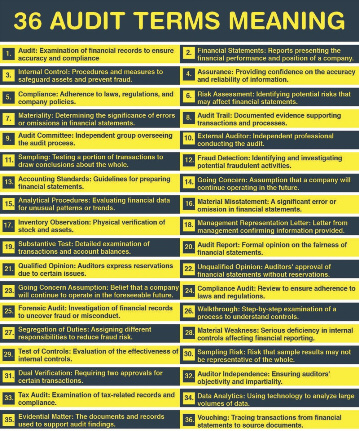
🔸 Audit: Examination of financial records to ensure accuracy and compliance.
🔸 Financial Statements: Reports presenting the financial performance and position of a company.
🔸 Internal Control: Procedures and measures to safeguard assets and prevent fraud.
🔸 Assurance: Providing confidence on the accuracy and reliability of information.
🔸 Compliance: Adherence to laws, regulations, and company policies.
🔸 Risk Assessment: Identifying potential risks that may affect financial statements.
🔸
Materiality: Determining the significance of errors or omissions in financial statements.
🔸 Audit Trail: Documented evidence supporting transactions and processes.
🔸 Audit Committee: Independent group overseeing the audit process.
🔸 External Auditor: Independent professional conducting the audit.
🔸 Sampling: Testing a portion of transactions to draw conclusions about the whole.
🔸 Fraud Detection: Identifying and investigating potential fraudulent activities.
🔸 Accounting Standards: Guidelines for preparing financial statements.
🔸 Going Concern: Assumption that a company will continue operating in the future.
🔸 Analytical Procedures: Evaluating financial data for unusual patterns or trends.
🔸 Material Misstatement: A significant error or omission in financial statements.
🔸 Inventory Observation: Physical verification of stock and assets.
🔸 Management Representation Letter: Letter from management confirming information provided.
🔸 Substantive Test: Detailed examination of transactions and account balances.
🔸 Audit Report: Formal opinion on the fairness of financial statements.
🔸 Qualified Opinion: Auditors express reservations due to certain issues.
🔸 Unqualified Opinion: Auditors' approval of financial statements without reservations.
🔸 Going Concern Assumption: Belief that a company will continue to operate in the foreseeable future.
🔸 Compliance Audit: Review to ensure adherence to laws and regulations.
🔸 Forensic Audit: Investigation of financial records to uncover fraud or misconduct.
🔸 Walkthrough: Step-by-step examination of a process to understand controls.
🔸 Segregation of Duties: Assigning different responsibilities to reduce fraud risk.
🔸 Material Weakness: Serious deficiency in internal controls affecting financial reporting.
🔸 Test of Controls: Evaluation of the effectiveness of internal controls.
🔸 Sampling Risk: Risk that sample results may not be representative of the whole.
🔸 Dual Verification: Requiring two approvals for certain transactions.
🔸 Auditor Independence: Ensuring auditors' objectivity and impartiality.
🔸 Tax Audit: Examination of tax-related records and compliance.
🔸 Data Analytics: Using technology to analyze large volumes of data.
🔸 Evidential Matter: The documents and records used to support audit findings.
🔸 Vouching: Tracing transactions from financial statements to source documents.